

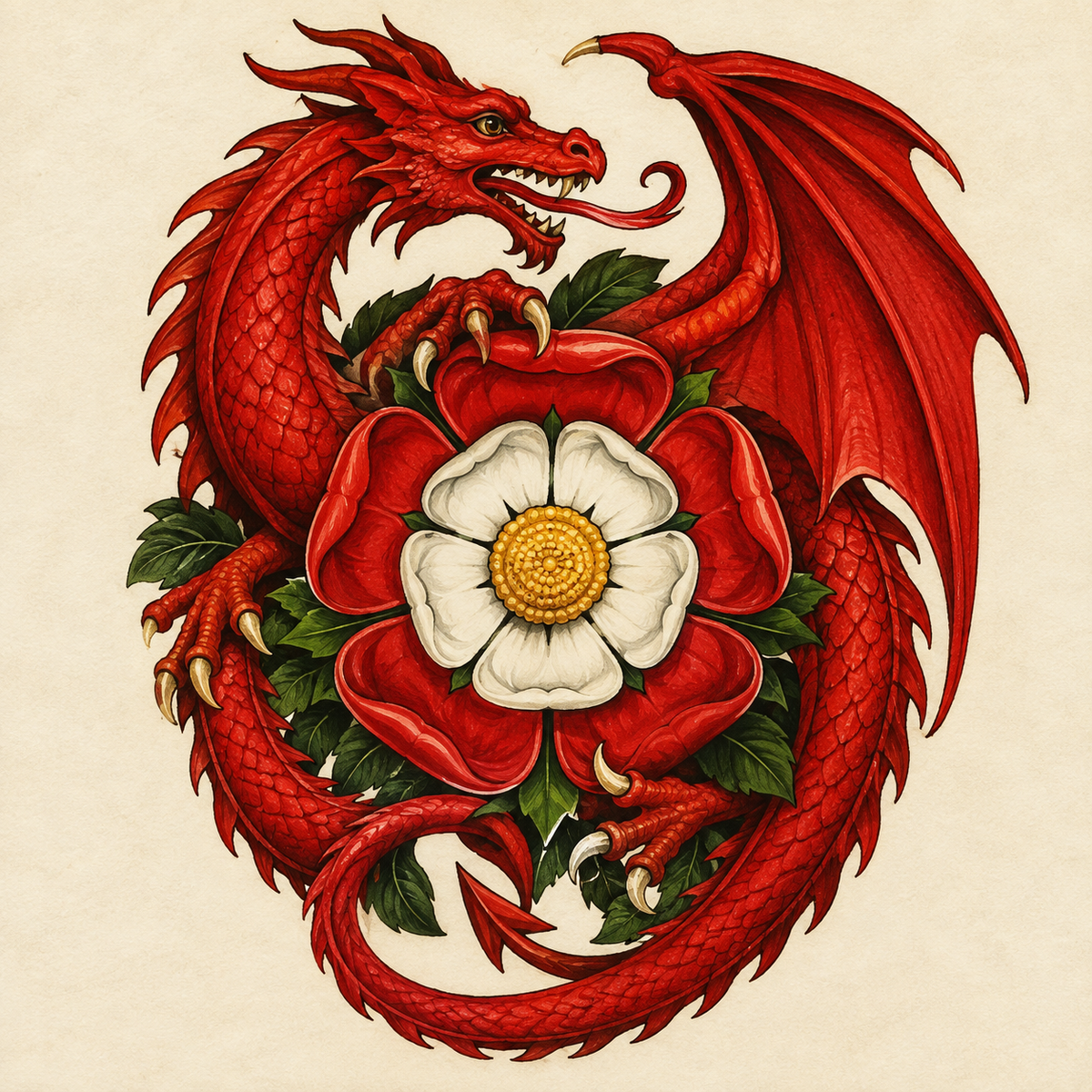
The Normans versus the Tudors
The war at the heart of The Siren's Daughter
1 Oct 2026
The part of The Siren’s Daughter which makes me the happiest is the fact that Nesta and Angharad’s family were the ancestors of the Tudors.
I love that this novel is essentially about a war between the Normans and the Tudors.
Of course, the characters in The Siren’s Daughter could not discuss this marvellous truth, because in their time (1126), the rise of the Tudors was hundreds of years in the future, and they had no idea that their descendants would one day seize the throne of England and put an indelible mark upon the world.
But, still, I like to think about it.
You might notice a few glancing references to the ‘descendants of Rhys ap Tewdwr’ that I enjoyed scattering into the text. And that a few of the novel’s characters have the trademark Tudor red hair.
Remarkably, some of the key hallmarks of the Tudors – the ruthlessness; the recklessness; the tendency towards infighting and backstabbing each other; and, above all, the extraordinary talent for self-publicity – were already evident amongst the characters in The Siren’s Daughter, almost all of whom are based on real historical figures.
Many people do not know that the Tudor dynasty (with Henry VIII, Elizabeth I and their assorted flamboyant relatives) was originally Welsh.
Nor is it much known that the Tudors originally rose to prominence in the twelfth century as an early medieval Welsh royal family, dispossessed of their throne by the Normans, leading resistance to the Norman Conquest.
The original spelling of the name was Tewdwr. It was derived from Celtic words meaning ‘people’ and ‘king’. Princess Nest’s grandfather bore the name, and so her father was known as Rhys ap Tewdwr (Rhys, son of Tewdwr).
The name was used by the family on and off over the generations, as a forename or a patronymic, until Owain ap Maredudd ap Tudur adopted the name Tudur as a fixed surname in the 1420s.
Then, it morphed into the more anglicized spelling Tudor when the family joined English court politics, sometime after Owen Tudur married Catherine of Valois in 1428 or 1429.
But in The Siren’s Daughter, all of this was an unimaginable future.
The only thing my characters knew was that their bloodline - which contained the occasional son who bore the name Tewdwr - was in dire peril. And that to fight back against the Norman Conquest was the only way to survive. And that not every member of their family would get a happy ending.
