

Medieval Women beyond Romance
Why I didn’t let Nesta fall in love with her conqueror
19 Jul 2026
One of the key questions I faced when writing The Siren’s Daughter was to define the relationship between Nesta (based on the legendary beauty, Princess Nest of Deheubarth) and her longest-lasting husband, Gerald of Windsor.
THE CHRONICLES
There is little evidence in the actual historical chronicles.
On the one hand, there are some signs of affection from Gerald towards Nest. He allowed the use of Welsh names, primarily for their female children, which signals a level of sentimental attachment. Moreover, Carew Castle, built for Nest, shows much thoughtfulness in design and is situated in a stunningly attractive spot – more of an aesthetic than a defensible location. Finally, noblemen at this time had options in the marriage market – if Gerald genuinely did not want to marry Nest, he could probably have avoided it.
On the other hand, Gerald was involved in the conquest of Nest’s kingdom, the killing of her father in battle, the killing of her half-brother Goronwy (either in battle or by execution immediately post-battle) and the castration of her younger brother Hywel. Plus, he would have been a part of whatever atrocities were committed against Nest’s wider household by the conquering Norman army. Nest would have had plenty of reasons to hate Gerald – and no say at all in the question of whether she married him.
A few factors helped me decide that Gerald would adore Nesta … and she would have an unshakeable loathing towards him.
THE TROPE
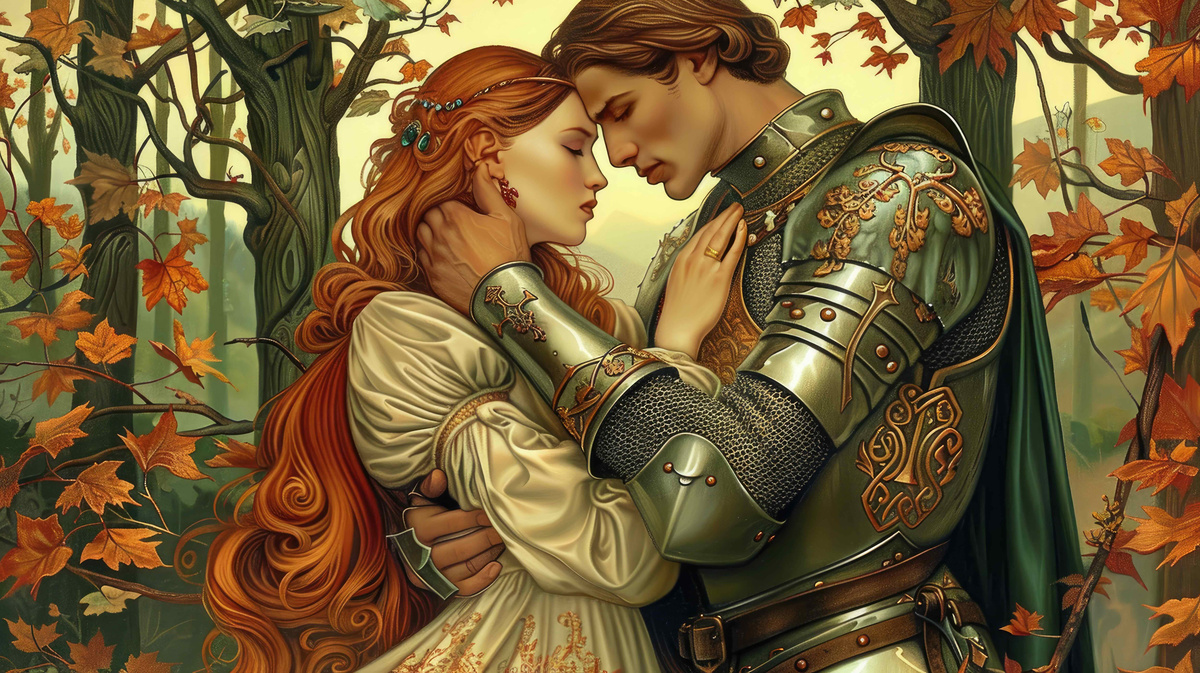
First, I feel that sometimes in historical romance, the female leads behave in an irrational way by falling for their conquerors. If the narrative is not developed well, this can make them seem inauthentic. If someone killed your father, caused your mother to ‘vanish from the historical record’ and mutilated your brother, how likely would you be to adore them? I am sceptical. Although historical romance is a wonderful genre and I hope someday to write it myself, I feel, when over-used, that the falling-for-your-conqueror trope can undervalue the discernment of women and make them seem shallow. Moreover, why should the passage of years change such women’s minds and turn enemies into lovers? People are eminently capable of having long, horrible marriages in which they cling onto emotions of rage, resentment or hatred for year after year after year. I think it is more realistic that Nesta would retain a dysfunctional relationship with the husband who slaughtered half her family, than that she would fall in love with him.
GIVING WOMEN THEIR OWN STORIES
Second, medieval women are very rarely written about in the historical chronicles; and when they are, they almost never get a story of their own. Instead, they tend to be shown in the context of men – too often as the passive and two-dimensional protagonist in a love story with a man. The medieval romances are fabulous, evocative tales … but why can’t more women have had their own stories? Hence my decision that the focus of this novel would not be a love story between Nesta and her husband, but instead a depiction of her complex and difficult love for her half-Norman daughter. I also enjoy the subversiveness of there being an epic, passionate, romantic, lifelong, of-the-ages love story buried inside this novel … but it being almost entirely ‘off camera’, involving a minor character, and disregarded as the emotional heart of the book.
THE TRUTH OF THE CONQUEST
Finally, one key defining feature of the Norman conquest of England and Wales was the Norman habit of killing the men they conquered and forcibly marrying the womenfolk – thereby ensuring that their own Norman-bred children would legally inherit the wealth and lands. A whole generation of women underwent this ordeal during the Norman Conquest. This tale of terrible private grief is, however, not told when we learn about the Conquest. Much is taught about the martial feats and the battles; we learn about desperate cavalry charges, fleets of ships tempest-tossed at sea, and King Harold with an arrow in his eye. But we do not learn about the vast wave of sexual abuse, the years of domestic violence, the lonely bereavements and the toxic marital relationships which were an integral element of the Conquest. Many of the Norman men setting sail so gloriously in the Bayeux Tapestry went on to marry women whose husbands fell in battle or were executed or murdered. But, although some of the female victims of forced marriages may have even been involved in physically embroidering the tapestries which glorified the Conquest, we almost never read the story of their pain.
Much is made of the Norman conquest of the English and Welsh men on the battleground. But the private, slow, brutal conquest of a nation of women which followed was the tale I wanted to tell.
And this is why Nesta cannot love her husband.
